

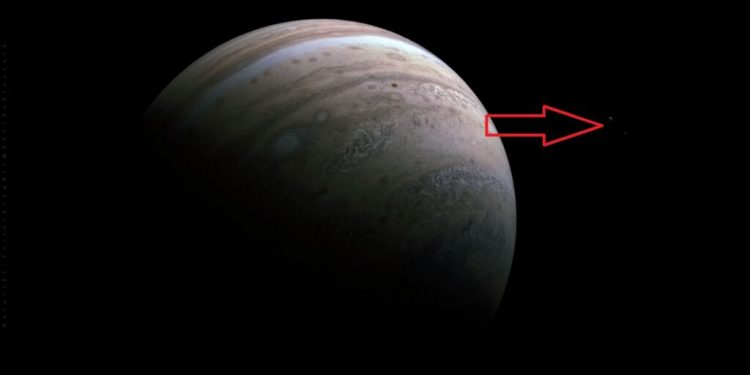
NASA’s Juno spacecraft is studying Jupiter, the king of the planets in the solar system.
However, Jupiter, which is 318 times larger than Earth, is not alone, it has many small “friends”.
The gas giant planet has 79 natural satellites (moons) known to us, one of which is larger than Mercury. Juno studies the relationship between some of these moons and planets, and sometimes, these photos also show these moons for Jupiter.
The new photo is so amazing that it looks like a work of science fiction. Jupiter is traditionally represented by stripes, specifically the southern hemisphere illuminated by the sun.
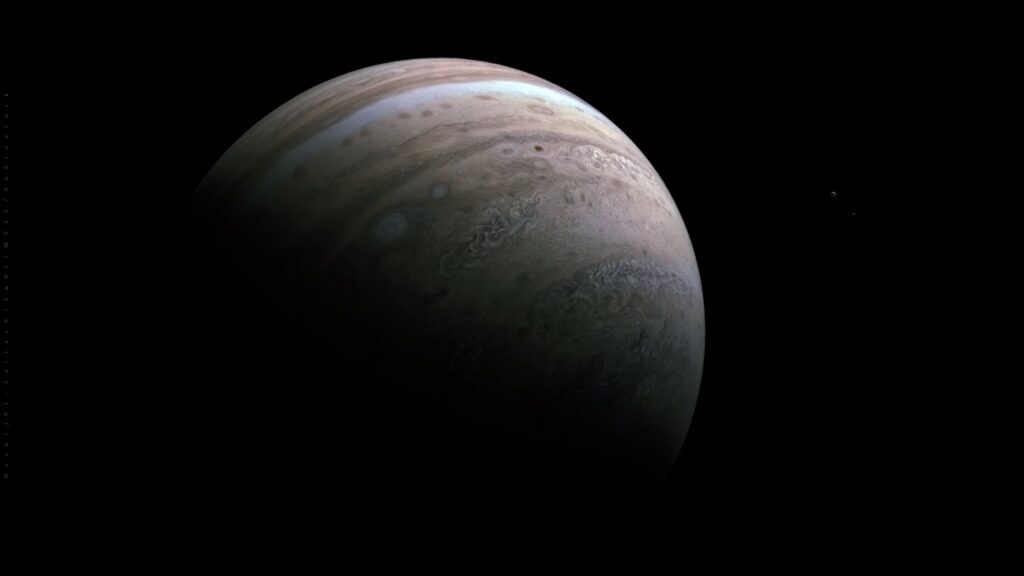
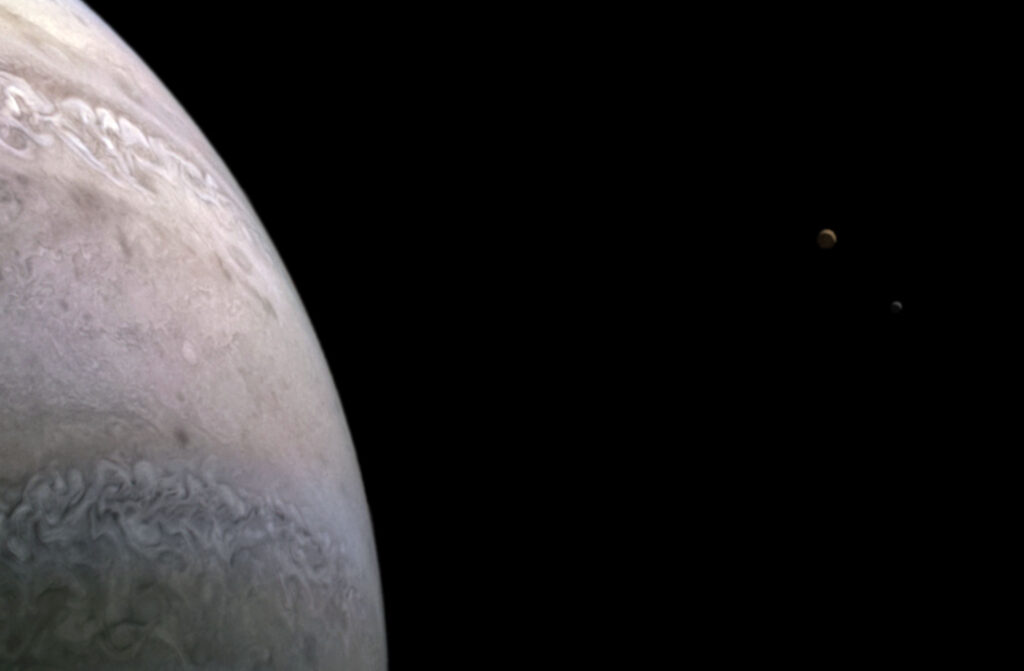
To the right of the giant planet are two small spots sunk into the sky. They are two of Jupiter, e. წ. The Galilean moons were discovered by Galileo Galilei.
This category includes four natural moons of Jupiter, and the photo shows two of the smallest of them: Io, with an equatorial diameter of 3643.2 kilometers; And Europe, with a diameter of 3121.6 kilometers.
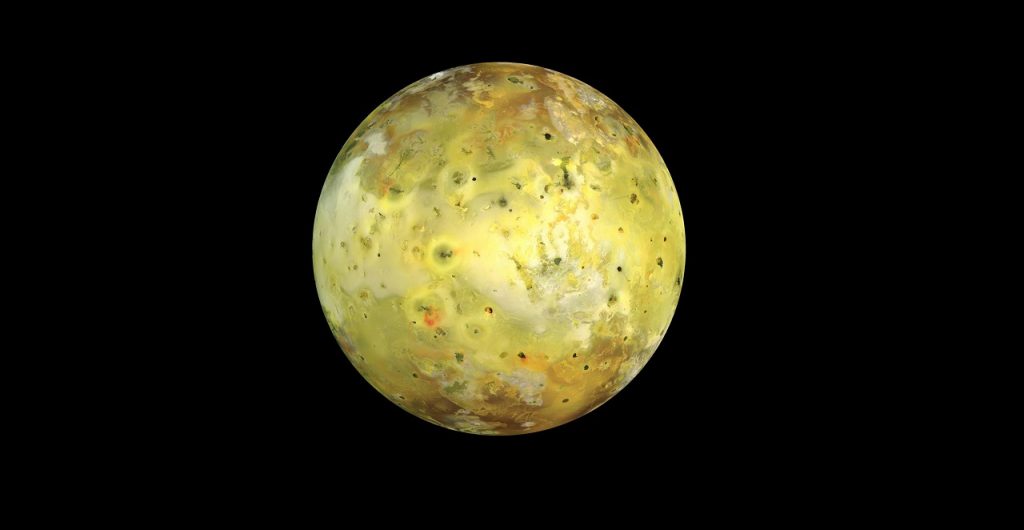
Each of these moons is an ideal target for research. Io is the most volcanically active body in the solar system, with more than 400 active volcanoes on its surface. The reason for this is the internal gravitational tension that Io experiences not only from Jupiter but also from other Galilean moons.
Due to volcanic activity, the atmosphere of Ios is rich in sulfur dioxide, which is emitted by volcanoes. The atmosphere constantly jumps and forms a plasma torus around Jupiter itself, which, along the magnetic field lines, descends down to the poles of Jupiter and causes a constant flux.
The constant eruption of sulfur also covers Joseph himself with various compounds of sulfur, which is why he is uniquely yellow.
As for the second moon, Europe, it is the target of the search for extraterrestrial life. An ocean of liquid water is hidden under its icy crust. Although this moon is far from the sun, it may be internally hot due to gravitational pull.
If so, there may be hydrothermal vents on its global ocean floor. Here on Earth, such pits are a veritable paradise for food networks based not on photosynthesis but on chemosynthesis: chemical reactions are used for food.
Because of this, astrobiologists think that icy moons in the solar system, including Jupiter’s Europa and Saturn’s moon Enceladus, may be places where we find extraterrestrial life.
These two moons, which are very different from each other, will fly Juno in the near future.
NASA will launch a mission to Europe in 2024, and in September of the same year it will fly Juno. This will be the last closest flight to this moon that any spacecraft has ever made. As for Ios, Juno will fly him in late 2023 and early 2024.
See also: NASA officially confirms that 5,000 exoplanets have already been discovered beyond the solar system

Discussion about this post