

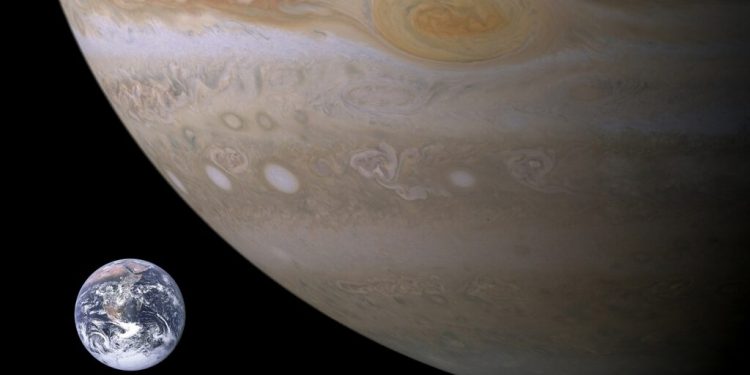
Currently, we know of the only place in the entire universe that is suitable for life: our Earth.
Therefore, when we look for life-friendly planets in other planetary systems beyond the solar system, we often use Earth as a perfect model.
However, new research suggests that Earth is not as conducive to life as it could be. In fact, it might be more habitable if Jupiter’s orbit shifted a little further.
The research is important because there are many moving parts and ingredients in the solar system, and determining which of them contributed to life on Earth is extremely difficult.
It could also help us better understand what makes planets suitable for life.
“If Jupiter’s location stays the same, but the shape of its orbit changes, the habitability of the planet may increase. Many are convinced that Earth is the epitome of a life-friendly planet, and any change in Jupiter’s orbit as a massive planet can only be bad for Earth. We have shown that both of these ideas are wrong,” says Pam Vervoort, a planetary scientist at the University of California, Riverside.
Such results also have implications for the search for life-friendly planets beyond the Solar System, as they provide a new set of parameters by which to evaluate the potential for life.
Although we currently have no tools that can definitively determine the habitability of exoplanets, or planets outside the solar system, based on several characteristics, scientists are amassing a population of planets that are worth close observations.
The first is where the exoplanet is in relation to its parent star—it needs to be not too close to the star for liquid water on its surface to evaporate, and not too far away for the water to freeze.
Another is the size and mass of the exoplanet—should it be rocky like Earth, Venus, or Mars, or gaseous like Jupiter, Saturn, and Uranus?
Scientists thought that the presence of a Jupiter-like gas giant in the same system could be a good sign for life. However, uncertainties remained.
In 2019, an international team of researchers published a study in which they showed, based on simulations, that changing Jupiter’s orbit could make the solar system unstable quite quickly.
This time, even more simulations showed the opposite, helping to narrow the range of orbits of gas giants, helping or hindering life.
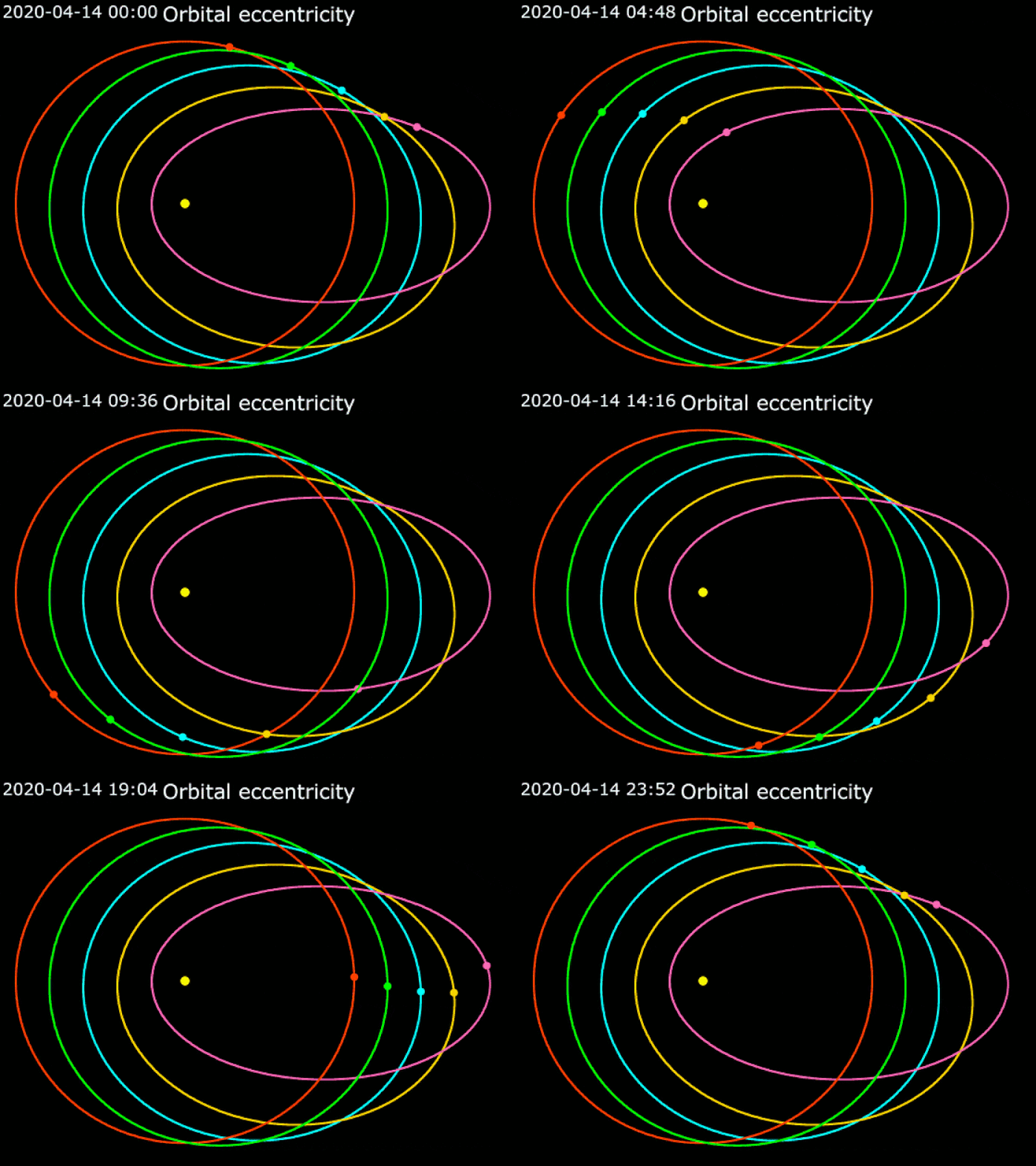
The study was based on the eccentricity of Jupiter’s orbit, that is, the rate of elongation and ellipticity of the orbit.
Currently, Jupiter has only a very slightly elliptical orbit; It is almost circular.
However, if this orbit is stretched, it will have a very noticeable effect on the entire solar system. Because Jupiter is so massive, its mass is 2.5 times that of all the planets in the solar system combined.
Changing Jupiter’s eccentricity will actually have a gravitational effect on the other planets.
In the case of Earth, this means increasing the eccentricity. That is, some parts of the planet will come closer to the Sun and heat up to a moderate, life-friendly range.
However, if we move Jupiter closer to the Sun, the suitability of Earth for life will be threatened. Because it will tilt our planet more sharply on its axis than it currently is; It is this inclination that causes the change of seasons.
A steeper tilt would result in a larger portion of our planet being frozen, with more extreme seasons. Winter sea ice will extend four times as far as it is now.
Such results can be applied to any multiplanet system we discover to assess its potential habitability, the researchers said.
The researchers also showed how many factors could influence our presence here, the faint blue dot, and how close we could be to an environment that never existed. Also, what might happen to the solar system if its stability were ever disturbed.
“The presence of liquid water on the surface is a very simple first measure, and it doesn’t take into account the shape of the planet’s orbit or the seasonal variations that the planet may have,” says astrophysicist Stephen Kane of the University of California, Riverside.
According to him, it is important to understand the influence that Jupiter has had on Earth’s climate over time, how much its effects have changed the Earth in our orbit, and how it may change in the future.
Prepared by news.ucr.edu and ScienceAlert.

Discussion about this post