

The moon is a witness of human history. Its gravitational influence is responsible for the tides, and even the mere presence of this celestial body in the night sky has had a significant impact on the cultural development of mankind. Nevertheless, there is still no consensus in the scientific community about how the natural satellite of the Earth was formed.
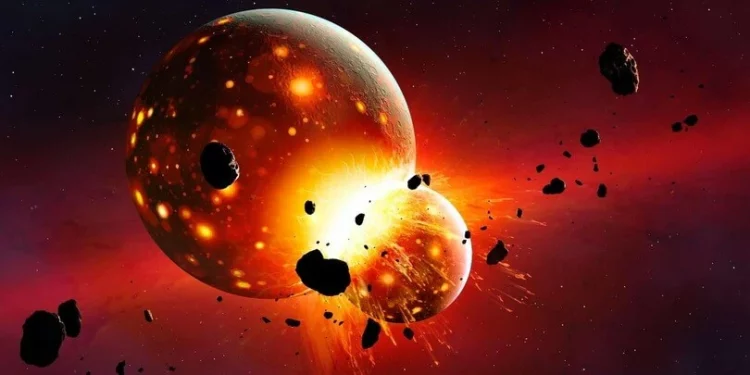
It is generally accepted that the Moon was formed when a Mars-sized solar system body — called Theia — collided with Earth about 4.5 billion years ago. The impact tore apart both our planet and primordial Theia, sending large amounts of material from both into Earth’s orbit.
Many previous theories of the Moon’s formation suggest that it slowly coalesced from orbital debris. In this scenario, the orbital debris consisted mainly of the remnants of Theia. However, rock samples taken from the lunar surface by Apollo-era astronauts have shown striking structural and isotopic similarities to those found on Earth.
While this is possible, the authors of the new study found it unlikely that the material from Theia would have matched that of Earth. In this study, a team of researchers from Durham University used the powerful DiRAC supercomputing facility to run a range of simulations to explain the formation of the Moon.
The supercomputer used a significantly larger number of particles to simulate ancient collisions than previous studies. According to the team, low-resolution simulations may miss important aspects of the collision process. During the study, the scientists ran hundreds of such high-resolution simulations and varied key parameters, including the two planets’ masses, spins, angles and velocities.
The simulations showed that a large body with a similar mass and iron content to the Moon could coalesce into orbit almost immediately after the Earth-Theia collision. Detailed simulations revealed that a hypothetical newly born satellite would form beyond the Roche limit—the orbital distance at which a satellite can orbit a planet without being destroyed by gravity.
In addition, the outer layers of such a body would be rich in material expelled from Earth, thus explaining the similarities between the Apollo-era rocks and the rocks of our planet.
“This formation pathway may help explain the similarity in isotopic composition between lunar rocks returned by Apollo astronauts and the Earth’s mantle,” explains study co-author Vincent Ecke, associate professor in the Department of Physics at the University of Exeter. “There may also be observable consequences for the thickness of the lunar crust, which would allow us to determine what kind of collision occurred.”
If the Moon formed quickly after the impact, then its internal structure would likely be different than if it had grown gradually from debris moving around the planet.
Astronauts returning to the moon in the coming decades as part of NASA’s Artemis program will collect new samples from the lunar surface that can be used to test the theory of rapid formation.
This research could help scientists update their knowledge of how moons form in the orbits of distant planets.
Source: IGN

Discussion about this post