

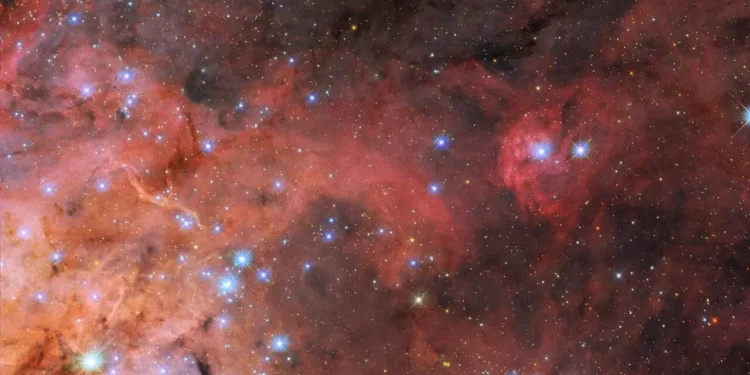
A stunning new view of the Tarantula Nebula captures turbulent clouds of gas and dust swirling between young stars.
Located 161,000 light-years away in the Large Magellanic Cloud, the Tarantula Nebula, also known as 30 Doradus, is the largest and brightest star-forming region in the Local Group — the galaxies nearest to the Milky Way. This new view comes from the Hubble Space Telescope and combines data collected during multiple observations.
The Tarantula Nebula houses the hottest and most massive stars known, making it the “perfect natural laboratory in which to test out theories of star formation and evolution,” European Space Agency representatives said in a statement. “A rich variety of Hubble images of this region have been released to the public in recent years.”
The Hubble image captures bright layers of ionized hydrogen gas — a key building block for new star formation — along with wispy, nebulous clouds and dark, obscuring dust. A cluster of small, bright blue stars can be seen in the bottom-left corner, while many much smaller stars are scattered across the backdrop of space.
Data from two different observations were used to create this new image of the Tarantula Nebula. The first project, named Scylla, aimed to study the properties of dust grains that make up the dark clouds that exist between stars. The second project, called Ulysses, explored how interstellar dust interacts with starlight in a variety of environments, according to the statement.
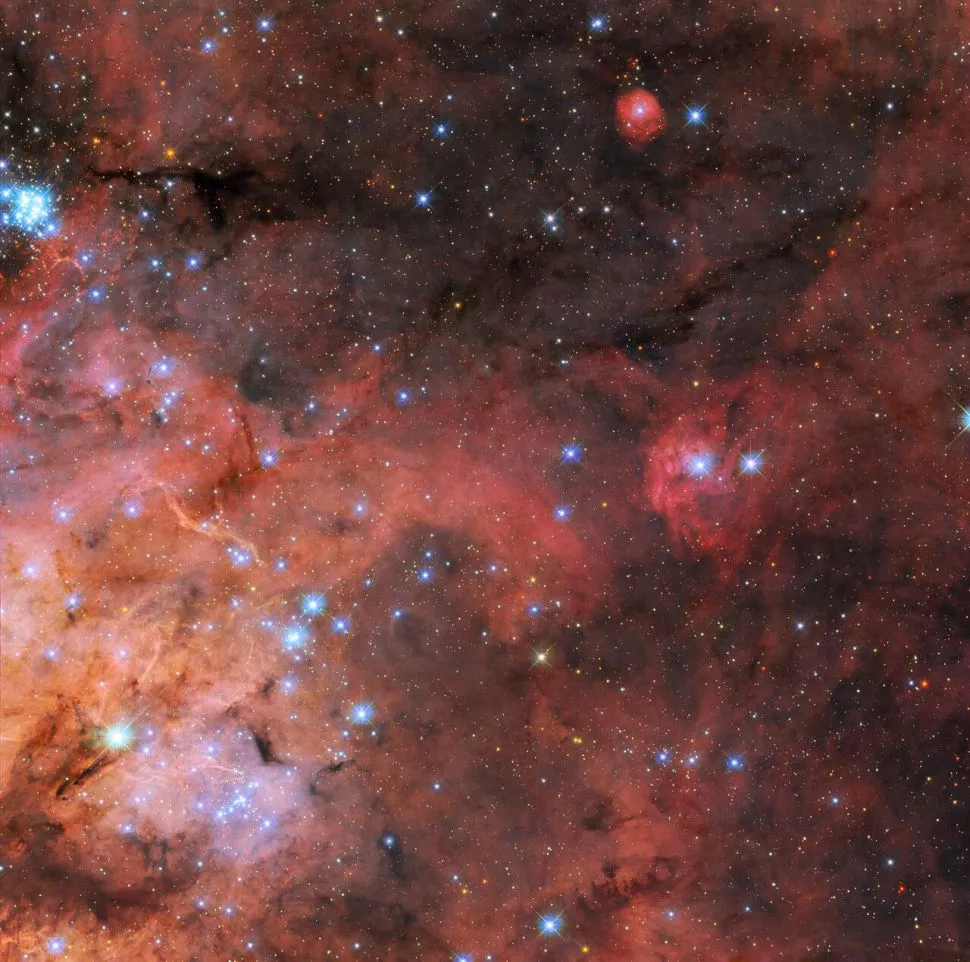
Another project geared toward studying star formation in conditions similar to those of the early universe and cataloging the stars of the Tarantula Nebula for future observations with NASA’s James Webb Space Telescope also aided in creating the new Hubble image.
Studying the Tarantula Nebula has helped astronomers better understand how stars are born and evolve. Webb, which launched Dec. 25, 2021, and released its first images in July 2022, also recently investigated this popular region, revealing thousands of never-before-seen young stars.
Source: space.com


Discussion about this post