

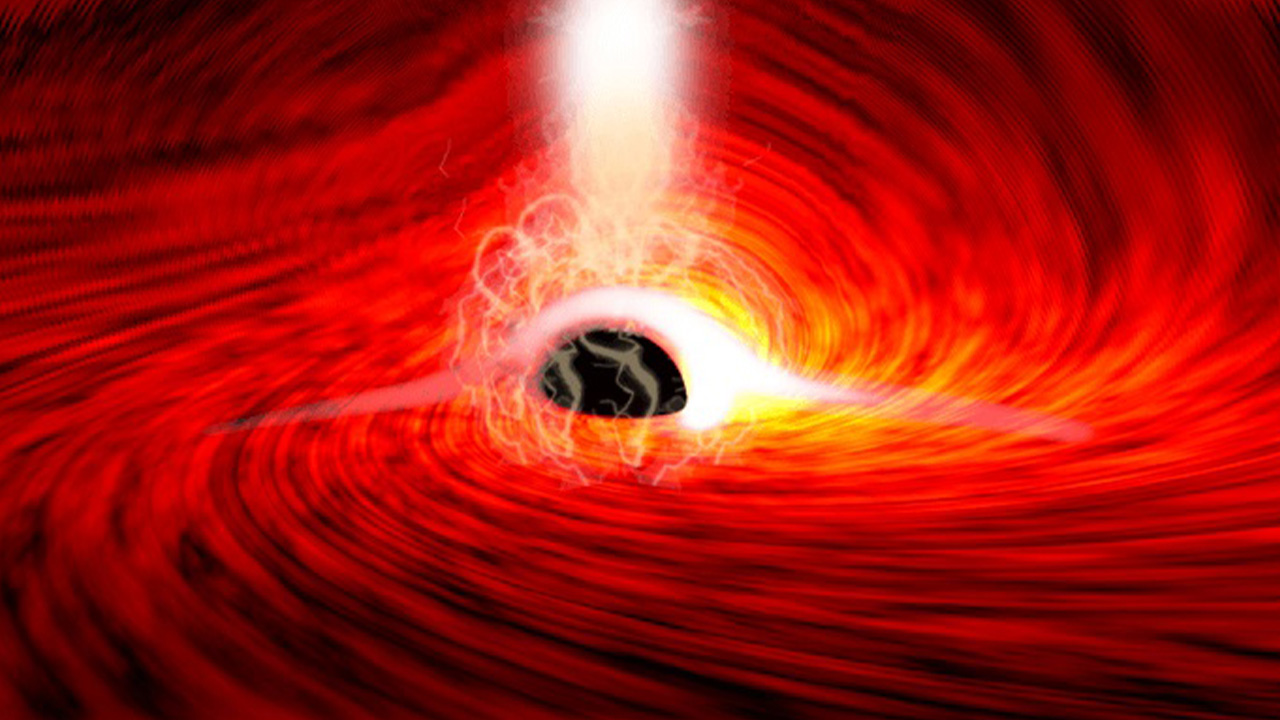
The magnetic and gravitational environment around the black hole is so extreme that we have to see the curvature of the light around it and it must be reflected from the back of the black hole to the observer. In any case, such are the theoretical predictions of Einstein’s general relativity.
The magnetic and gravitational environment around the black hole is so extreme that we have to see the curvature of the light around it and it must be reflected from the back of the black hole to the observer. In any case, such are the theoretical predictions of Einstein’s general relativity.
“Any light that enters a black hole can not come back, therefore, we should not see anything behind the black hole. “The reason we see X-ray echoes is because a black hole distorts space, refracts light, and twists magnetic fields around itself,” said Dan Wilkins, an astrophysicist at Stanford University.
The black hole has several components in the immediate vicinity of the space. There is a horizon of events – the famous “point of no return”, from which even the speed of light is not enough to reach the second cosmic speed.
The active black hole I Zw 1 * has an accretion plate. It is a huge, flattened disk of gas and dust flowing through a black hole that moves around it and flows into the black hole like water in a drainage well.
Due to the influence of friction and magnetic field, this plate heats up incredibly, so much so that electrons fall from the atoms and form a magnetized plasma.
Outside the active black hole event horizon, inside the inner edge of the accretion disc is the corona. This is a region composed of incredibly hot electrons fed by a black hole magnetic field.
The magnetic field is so twisted that it breaks down and reconnects – a process that also occurs in our sun and causes powerful eruptions. In a black hole, the corona acts as a kind of synchrotron, which accelerates electrons to such high energies that they shine very brightly at X-ray wavelengths.
“This magnetic field merges and then breaks off near the black hole, which heats everything around it and generates these high-energy electrons, which then emit X-rays,” explains Wilkins.
Some photons of X-rays irradiate the accretion disk and are recycled by processes such as photoelectric absorption and fluorescence; It then radiates again – this is called a reflected echo and indicates a reflection in the X-ray spectrum. This reflected radiation can be used to study the nearest region of the black hole event horizon.
It was the mysterious corona that Wilkins and his team were trying to study when they began researching the supermassive black hole I Zw 1 *. They observed its galaxy in January 2020 with two X-ray observatories, NUStar and XMM-Newton.
The data showed the expected X-ray inflammations, but then, they came across something unexpected – a small amount of X-ray light, later gleaming in other parts of the spectrum.
Wilkins realized that this was in line with the reflections on the back of the black hole, as their paths curve around a massive object with an incredibly powerful magnetic field, and their light is amplified by the effect of a loop.
“For several years now, I have been making theoretical predictions about how these echoes might appear to us. I had already seen them in the theory I had created, and when I saw them in the telescope data, I could easily identify them, ”explains Wilkins.
It’s nice to see you confirm another key prediction of general relativity, but this finding is exciting for several other reasons.
First of all, it’s really confusing to understand anything new about black holes. They are so intact space objects that observational research is fraught with many difficulties.
In addition, it indicates how far we have come that we can already make these kinds of observations, both with our tools and analytical methods. According to researchers, the science of black holes is only getting better, and a new generation of telescopes is opening up a whole new eye to the sky.
The study was published in the journal Nature.

Discussion about this post