

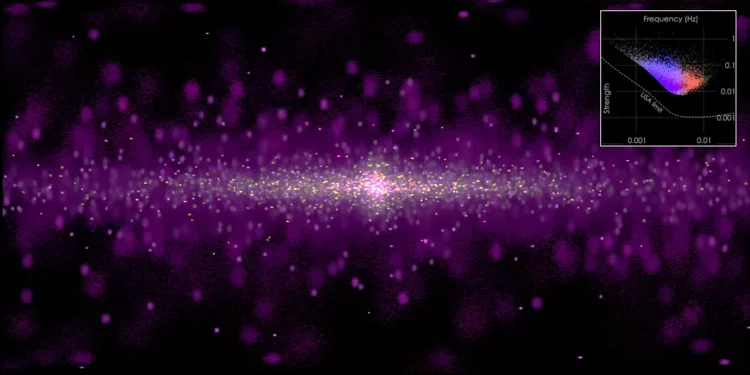
A simulated map of the Milky Way as it would appear in gravitational waves has given a powerful impression of what future space-based detectors will observe.
Over 90 gravitational-wave events have been detected so far by the triumvirate of ground-based detectors — the Laser Interferometer Gravitational-Wave Observatory (LIGO) in the U.S., Virgo in Italy and KAGRA in Japan. All these detected events are mergers of stellar-mass black holes and/or neutron stars in distant galaxies; no gravitational-wave events have been found coming from our Milky Way galaxy.
However, our galaxy is filled with so-called ultracompact binaries, which used to be binary stars but which have since evolved to become stellar remnants.
“Binary systems … fill the Milky Way, and we expect many of them to contain compact objects like white dwarfs, neutron stars and black holes in tight orbits,” said Cecilia Chirenti, of the University of Maryland and NASA’s Goddard Space Flight Center, in a statement. “But we need a space observatory to ‘hear’ them because their gravitational waves hum at frequencies too low for ground-based detectors.”
Earth-bound observatories such as LIGO are able to detect gravitational waves of frequencies between 5 and 20,000 Hertz. Ultracompact binaries in our galaxy, as they spiral around each other and eventually merge, have frequencies in the range of milliHertz.
Several space-based gravitational-wave detectors are in the works. The European Space Agency’s Laser Interferometer Space Antenna (LISA) is at the forefront, with launch projected to be in the 2030s, while Chinese scientists also have two mission concepts, named TianQin and Taiji, respectively.
Chirenti is part of a team, led by Kaitlyn Szekerczes of the Gravitational Astrophysics Laboratory at NASA Goddard, who have now simulated the intensity and frequency of gravitational waves emitted by ultracompact binaries in the Milky Way. The resulting image shows how observatories such as LISA will be able to study the Milky Way in gravitational waves just like astronomers study it in X-rays, gamma rays and so on. The simulated image shows ultracompact binaries concentrated in the plane of the Milky Way’s spiral disc and spilling out into the galactic halo.
“Our image is directly analogous to an all-sky view of the sky in a particular type of light, such as visible, infrared or X-rays,” said team-member James Ira Thorpe, who is also based at NASA Goddard. “The promise of gravitational waves is that we can observe the universe in a totally different way, and this image really brings that home.”
To date, astronomers know of only a handful of ultracompact binaries with orbital periods less than an hour, which would place the compact objects close enough to each other to emit detectable gravitational waves. Finding them is difficult, because neutron stars and black holes do not emit much light. This is where LISA will come in: ultracompact binaries should radiate brightly in gravitational waves, allowing LISA to discover tens of thousands of them.
The shorter the orbital period of an ultracompact binary, the higher the frequency and the lower the amplitude of the gravitational waves they emit. If they are really close together, there may even be some mass transfer between the two objects that astronomers could follow up on with optical, X-ray and gamma-ray telescopes. Scientists refer to this fusing of electromagnetic and gravitational-wave observations as “multi-messenger astronomy.”
Details of the simulated image were published in a paper in The Astronomical Journal this past June.
Source: Space.com

Discussion about this post