
World News, Show Bussiness, Science - Technology, health, Crypto Currency - Viadiplomacy.org
  • Hollywood
  • Elon Musk
  • Astronomy
  • Science
  • Technology
No Result
View All Result
Viadiplomacy
  • Hollywood
  • Elon Musk
  • Astronomy
  • Science
  • Technology
No Result
View All Result
VIADIPLOMACY
No Result
View All Result

James Webb Space Telescope spots baby stars cocooned in the Orion Nebula

The Orion Nebula is one of the brightest star-forming regions visible in the night sky even with the naked eye.

4 years ago
in Astronomy
17 1
0
James Webb Space Telescope spots baby stars cocooned in the Orion Nebula

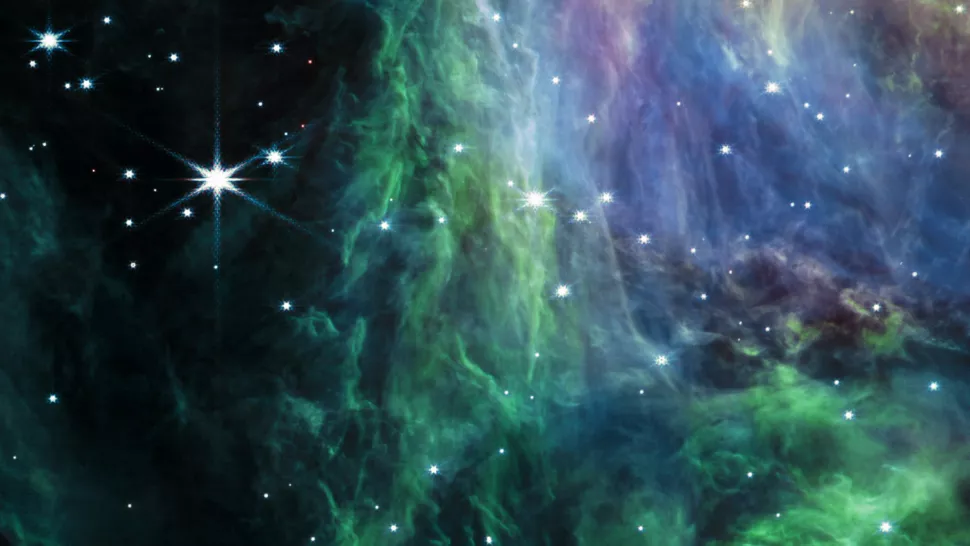
The Orion Nebula captured in unprecedented detail in this image by the James Webb Space Telescope. (Image credit: NASA, ESA, CSA, Data reduction and analysis : PDRs4All ERS Team; graphical processing S. Fuenmayor)

7
SHARES
Share on FacebookShare on Twitter

Newborn stars still wrapped in cocoons of dust and gas are revealed in a new image of the famous Orion Nebula captured by the James Webb Space Telescope.

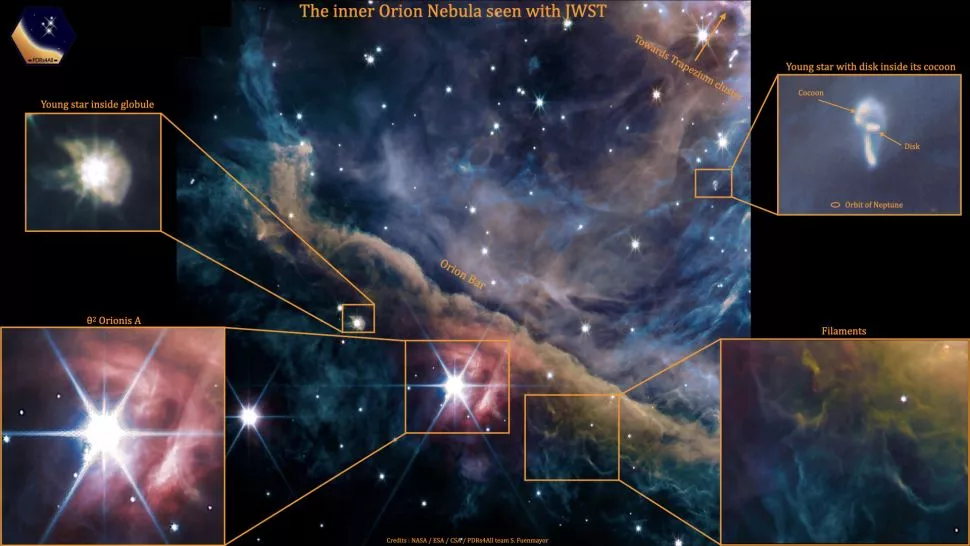
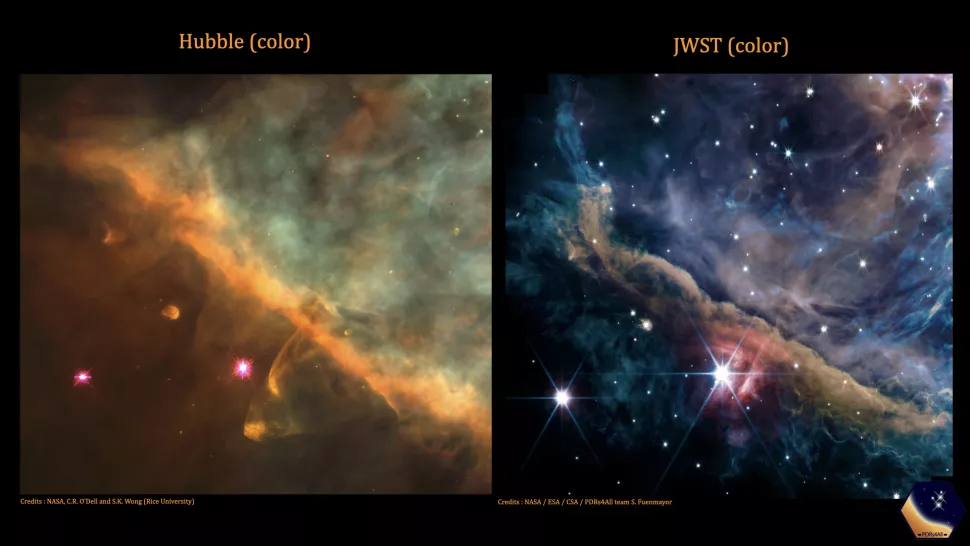
The image, taken on Sunday (Sept. 11) with the James Webb Space Telescope’s NIRCam instrument reveals unprecedented details of the Orion Nebula, a known star-forming region that is visible even to the naked eye. Fine structures in the dense dust and gas clouds that form the nebula come to the fore in the image with much greater clarity than in a previous image captured by Webb’s predecessor, the Hubble Space Telescope.

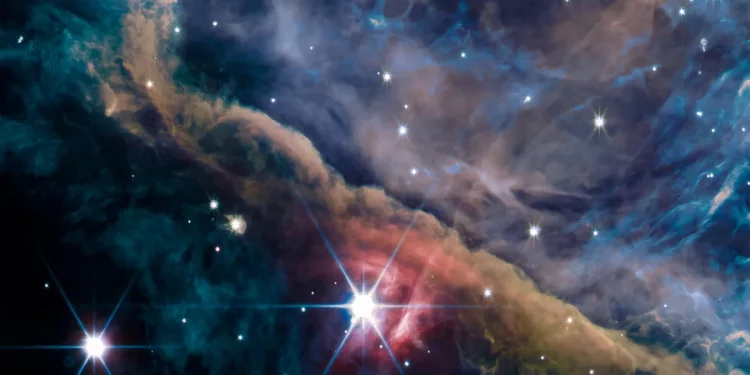
The nebula, which can be found in the night sky in the constellation Orion just south of the archer’s belt, features a wall of dense gas and dust known as the Orion Bar. Inside this bar, energetic photons from stars in the Trapezium cluster (in the top right corner of the image) mix with a molecular cloud, triggering complex ionizing reactions. At the center of the bar, the star Theta2 Orionis A (or θ2 Ori) shines brightly with the characteristic diffraction spikes that are a side-effect of the design of the James Webb Space Telescope’s mirror.
Orion Nebula detail
The James Webb Space Telescope reveals the Orion Nebula in unprecedented detail. (Image credit: NASA, ESA, CSA, Data reduction and analysis : PDRs4All ERS Team; graphical processing S. Fuenmayor & O. Berné)

The image also reveals newborn stars at various stages of their development. Toward the upper left corner of Theta2 Orionis A, inside the bar, is a young star forming inside a globule, a shroud of dust and gas that has collapsed together under the force of gravity to give rise to the new star. On the right-hand side, below the Trapezium cluster, is a star wrapped in a cocoon of planet-forming material that is being eroded by the strong ultraviolet radiation from the Trapezium stars.
Hubble and ames Webb Space Telescope
An image of the Orion Nebula captured by the Hubble Space Telescope on the right and one by the James Webb Space Telescope on the left.(Image credit: NASA, ESA, CSA, PDRs4All ERS Team; image processing Olivier Berné. /NASA/STScI/Rice Univ./C.O’Dell )
Spitzer
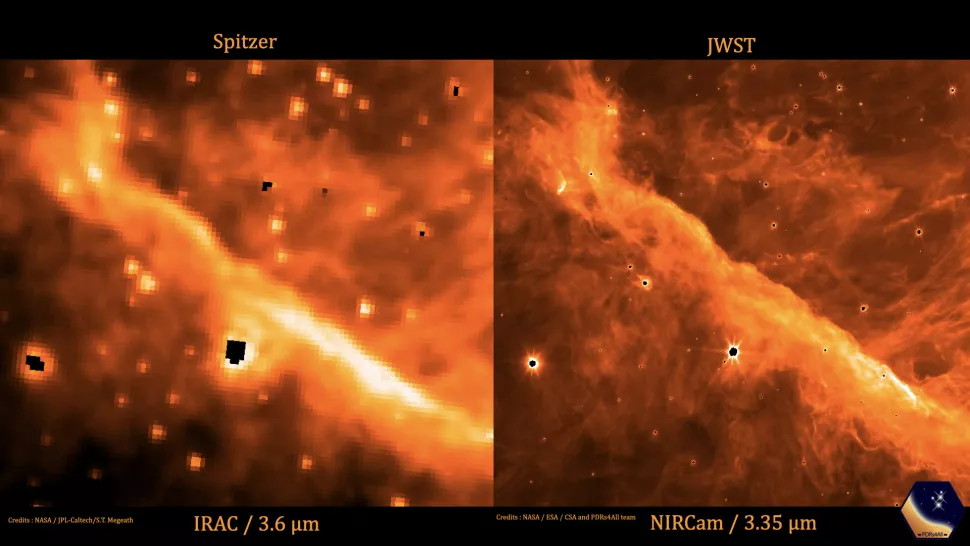
The Orion Nebula seen by the older Spitzer Space Telescope (on the left) and through the eyes of the James Webb Space Telescope (on the right).(Image credit: NASA, ESA, CSA, PDRs4All ERS Team; image processing Olivier Berné. / NASA/JPL-Caltech/T. Megeath )
Orion Nebula eyes
The Orion Nebula through the eyes of the James Webb Space Telescope.(Image credit: NASA, ESA, CSA, Data reduction and analysis : PDRs4All ERS Team; graphical processing S. Fuenmayor)

The star in this image, called HST-10, is one of about 180 young stars with “photo-evaporating disks” that have been discovered in the Orion Nebula, scientists said in a statement.

The image, a composite created by stacking multiple photos taken with several different filters, also reveals twisting filaments of hydrocarbon-rich dust and gas.

A comparison image captured with the Spitzer Space Telescope, NASA’s earlier infrared observatory, highlights the technological advances accomplished through the James Webb Space Telescope and the superb level of detail provided by the new telescope.

Source: space.com
Tags: James Webb Space TelescopeOrion Nebula
Share3Tweet2Share1

Related Posts

Scientists find rare double-star system where one star orbited inside the other
Astronomy

Scientists find rare double-star system where one star orbited inside the other

11 months ago
How NASA’s Roman Space Telescope will illuminate cosmic dawn
Astronomy

How NASA’s Roman Space Telescope will illuminate cosmic dawn

2 years ago
Astronomers Reveal Stunning Image of Baby Star Coming Into Existence
Astronomy

Astronomers Reveal Stunning Image of Baby Star Coming Into Existence

2 years ago

Discussion about this post

© 2021 Viadiplomacy.org

No Result
View All Result
  • Hollywood
  • Elon Musk
  • Astronomy
  • Science
  • Technology

© 2021 Viadiplomacy.org

Welcome Back!

Login to your account below

Forgotten Password?

Retrieve your password

Please enter your username or email address to reset your password.

Log In