

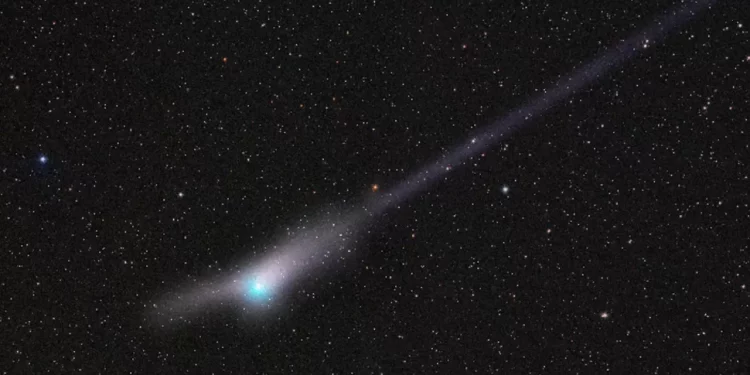
A rare green comet, which has been streaking across the night sky as it approaches Earth for the first time since the Stone Age, briefly grew a bizarre third tail. This “anti-tail” appeared to streak in the wrong direction, seemingly breaking the rules of physics.
The comet — named C/2022 E3 (ZTF) but more commonly referred to as the “green comet” thanks to a chemical reaction that emits a greenish glow around the cosmic cannonball — was first discovered in March 2022 heading towards Earth from the Oort Cloud, a collection of icy objects in the outer solar system.
Normally, comets like this have two tails: One made from dust, which is blown off the comet by solar wind; and one made of gas from within the comet that sublimates, or transitions, directly from solid to gas. But on Jan. 21, several astrophotographers, including Ruslan Merzlyakov in Denmark and Alessandro Carrozzi in Italy, snapped pictures of the green comet with a third tail that was pointed towards the sun instead of away from it.
This bizarre third tail is known as an “anti-tail,” and although it is made up from the same stuff as the comet’s other tails, it is not actually part of the comet. Instead, it’s an optical illusion caused by Earth moving through the comet’s orbital plane, according to Spaceweather.com.
A comet’s twin tails are often clearly visible — the dust tail reflects sunlight, while the gas within the other tail becomes ionized, giving it a faint glow.

The released gas eventually cools and becomes invisible, but the leftover dust is left to drift in the wake of the comet’s trajectory around the sun, or orbital plane. When Earth crosses through a comet’s orbital plane, some of this dust is reilluminated by the sun and appears as a bright streak, which can appear to shoot out of the comet in the opposite direction to its other tails, depending on the comet’s trajectory and orientation.
But in reality, this is just an optical illusion, and there is no extra tail.
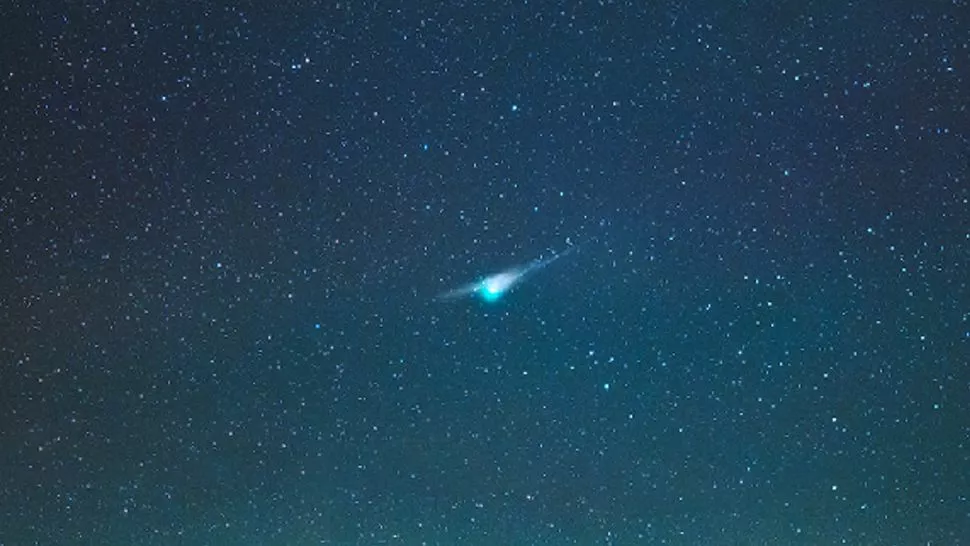
This illusion is similar to how the Milky Way appears as a bright band across the night sky because we are looking at the galaxy’s plane side-on. But instead of looking across our galaxy’s plane, we are looking across the comet’s plane around the sun, according to Universe Today.
Other notable comets that have been observed with an anti-tail include Comet Kohoutek in 1973, Comet Hale–Bopp in 1997 and Comet PanSTARRS in 2013.
This is not the first time that the green comet’s tails have made headlines. On Jan. 12, the green comet was clearly visible in the night sky as it reached its perihelion, or closest point to the sun, which caused its small atmosphere, or coma, to glow brighter than normal. On Jan. 17, one of the comet’s tails briefly separated mid-stream as it was blasted by extreme solar winds from a coronal mass ejection.
If you’ve missed the comet so far, don’t worry; it will become visible to the naked eye again in late January as it approaches its closest point to Earth on Feb. 1. Experts calculate that the last time the comet flew this close to Earth was around 50,000 years ago, when Homo sapiens were still sharing the planet with Neanderthals.
Originally published on LiveScience.com. Source: Space.com

Discussion about this post