
World News, Show Bussiness, Science - Technology, health, Crypto Currency - Viadiplomacy.org
  • Hollywood
  • Elon Musk
  • Astronomy
  • Science
  • Technology
No Result
View All Result
Viadiplomacy
  • Hollywood
  • Elon Musk
  • Astronomy
  • Science
  • Technology
No Result
View All Result
VIADIPLOMACY
No Result
View All Result

Webb’s wide-angle view of the Orion Nebula is released on ESASky

3 years ago
in Astronomy
8 0
0
Webb’s wide-angle view of the Orion Nebula is released on ESASky

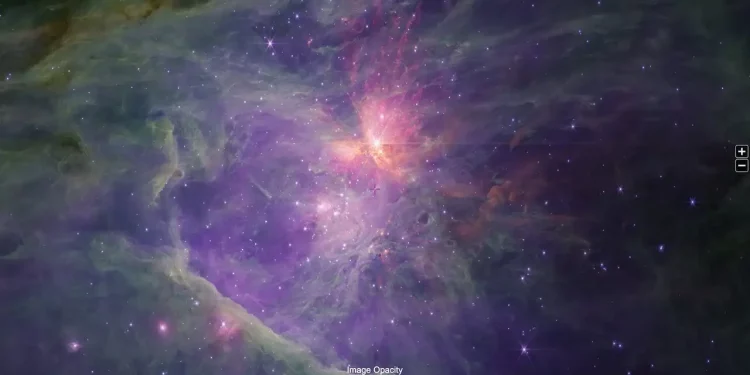
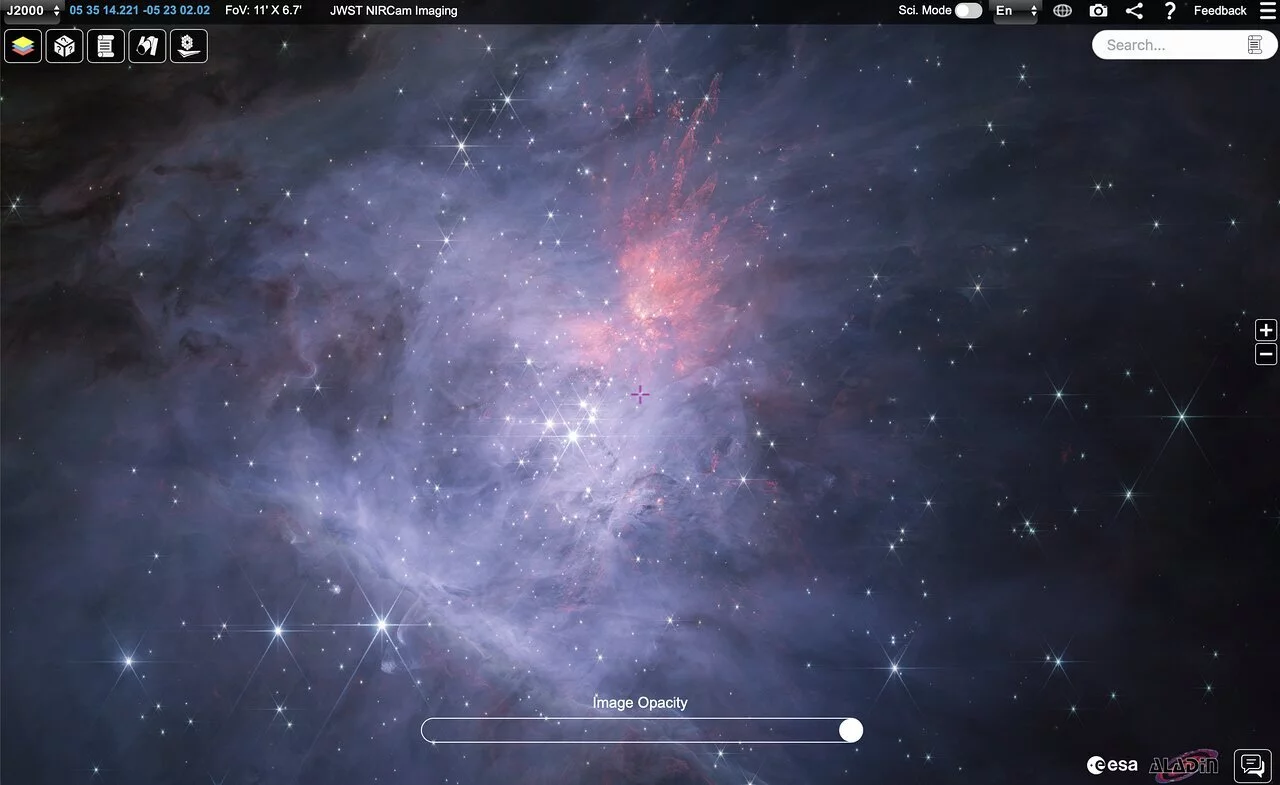
This image shows a long-wavelength NIRCam mosaic of the inner Orion Nebula and Trapezium Cluster in the ESA Sky platform. Credit: NASA, ESA, CSA; Science leads and image processing: M. McCaughrean, S. Pearson

3
SHARES
Share on FacebookShare on Twitter

New images of the Orion Nebula from the NASA/ESA/CSA James Webb Space Telescope have been included in ESA’s ESASky application, which has a user-friendly interface to visualize and download astronomical data.

One of the brightest nebulae in the night sky is Messier 42, the Orion Nebula, located south of Orion’s belt. At its core is the young Trapezium Cluster of stars, the most massive of which illuminate the surrounding gas and dust with their intense ultraviolet radiation fields, while protostars continue to form today in the OMC-1 molecular cloud behind.

The nebula is a treasure trove for astronomers studying the formation and early evolution of stars, with a rich diversity of phenomena and objects, including: outflows and planet-forming disks around young stars; embedded protostars; brown dwarfs; free-floating planetary mass objects; and photodissociation regions—the interface regions where the radiation from the massive stars heats, shapes and influences the chemistry of the gas.
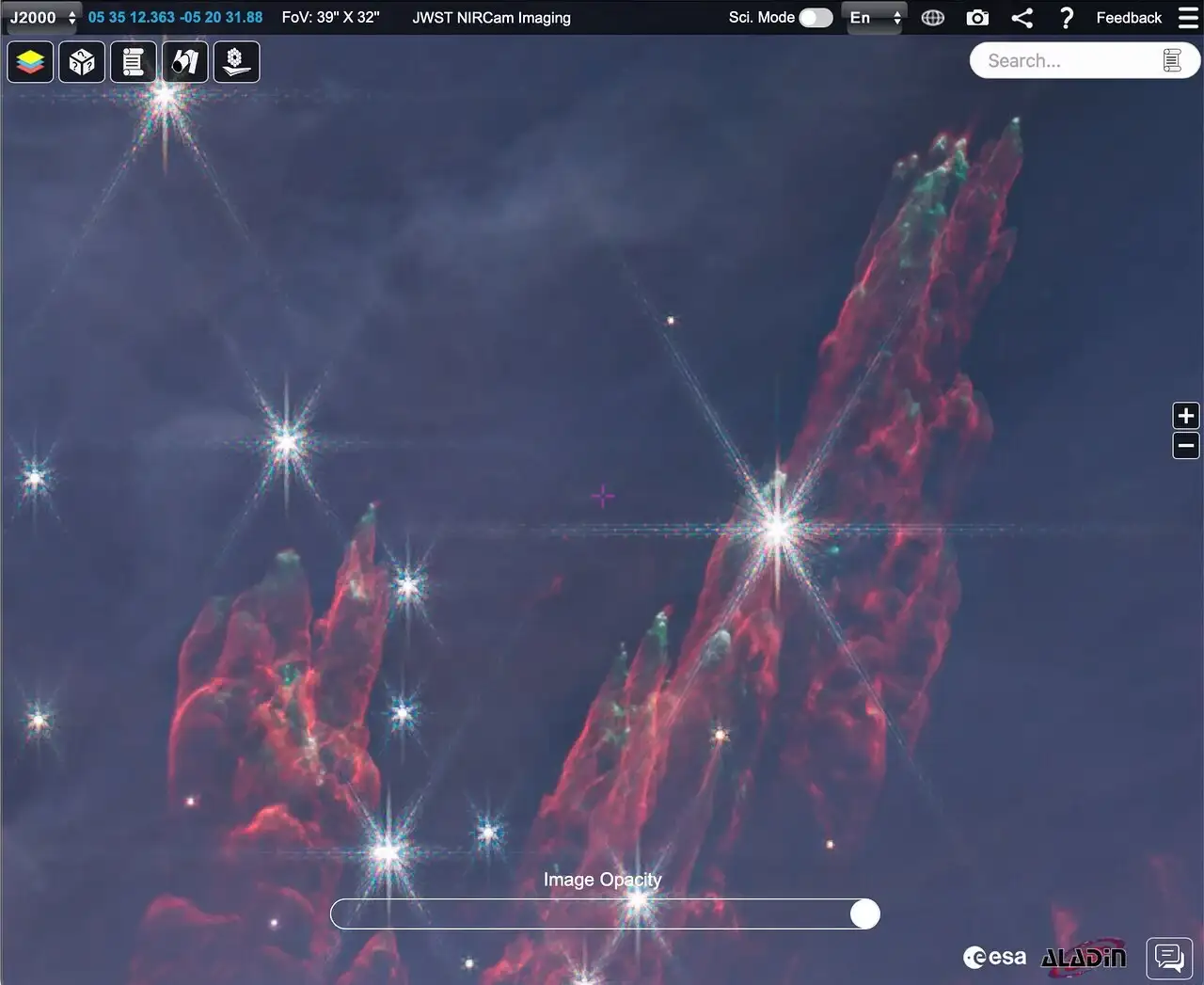
central star-forming
This is a screenshot from the ESA Sky platform showing some of the ‘fingers’ emanating from the central star-forming ‘BN-KL’ region in the short-wavelength mosaic behind the Trapezium Cluster and visible Orion Nebula. These fingers are expanding rapidly at hundreds of kilometres per second away from an explosive event that took place in the BN-KL region 500 to 1,000 years ago. They appear red because they emit in shocked molecular hydrogen and the green tips are due to ionised iron. Credit: NASA, ESA, CSA; Science leads and image processing: M. McCaughrean, S. Pearson

The new imaging was obtained with Webb’s near-infrared camera, NIRCam, and has been made into two mosaics, one each from the short and long wavelength channels.

These are among the largest Webb mosaics observed to date and given the high resolution and large area, they have been incorporated in ESASky to enable easy exploration of the plethora of interesting astronomical sources contained within them. The short-wavelength mosaic maximizes Webb’s angular resolution to reveal beautiful details in disks and outflows, while the long-wavelength one showcases the intricate network of dust and organic compounds called polycyclic aromatic hydrocarbons. We encourage you to explore these images to see what hidden treasures you can find.
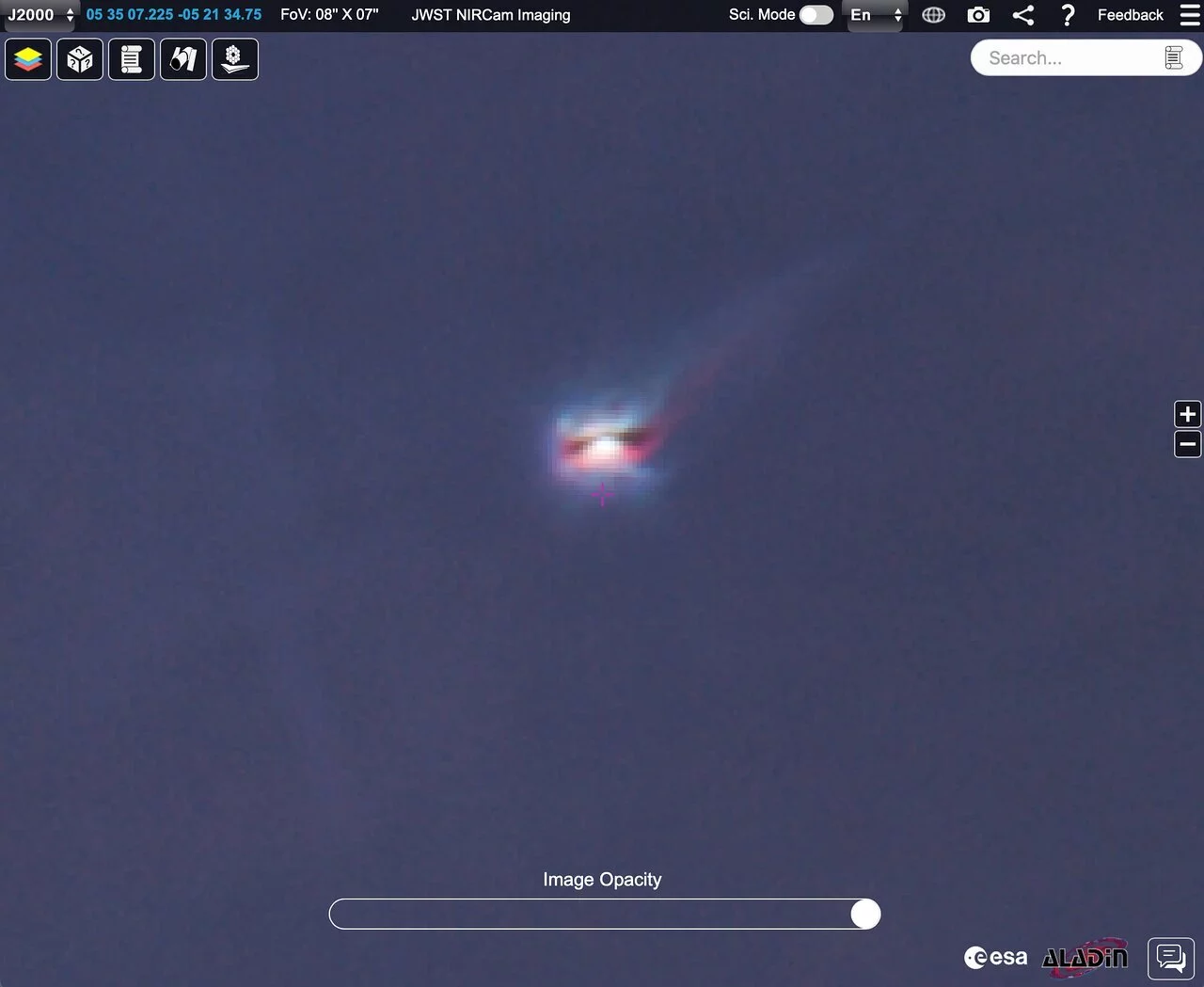
ESA Sky platform
This is a screenshot from the ESA Sky platform showing d072-135, one of the interesting objects in the short-wavelength mosaic. This shows a circumstellar disk as a silhouette against the background nebula, being heated and evaporated by the Trapezium stars, forming a colorful tail of molecular and ionized gas. Credit: NASA, ESA, CSA Science leads and image processing: M. McCaughrean, S. Pearson
NIRCam mosaic
This image shows a short-wavelength NIRCam mosaic of the inner Orion Nebula and Trapezium Cluster. It shows a region 4 light years across, slightly less than the distance between the sun and our nearest neighbor, Proxima Centauri. Credit: NASA, ESA, CSA Science leads and image processing: M. McCaughrean, S. Pearson

Source: phys.org

Tags: James Webb Space TelescopeOrion NebulaWebb
Share1Tweet1Share

Related Posts

Scientists find rare double-star system where one star orbited inside the other
Astronomy

Scientists find rare double-star system where one star orbited inside the other

11 months ago
How NASA’s Roman Space Telescope will illuminate cosmic dawn
Astronomy

How NASA’s Roman Space Telescope will illuminate cosmic dawn

2 years ago
Astronomers Reveal Stunning Image of Baby Star Coming Into Existence
Astronomy

Astronomers Reveal Stunning Image of Baby Star Coming Into Existence

2 years ago

Discussion about this post

© 2021 Viadiplomacy.org

No Result
View All Result
  • Hollywood
  • Elon Musk
  • Astronomy
  • Science
  • Technology

© 2021 Viadiplomacy.org

Welcome Back!

Login to your account below

Forgotten Password?

Retrieve your password

Please enter your username or email address to reset your password.

Log In