


Scientists have discovered a new exoplanet moving in a binary star system. Its orbit does not correspond to the plane of the luminaries’ orbits. The new finding may help us understand more about the formation of similar celestial bodies.
It should be noted that the specialists determined the three-dimensional structure of the orbits of the objects included in this system, which they consider an important achievement. The gas giant exoplanet they observed is GJ 896Ab, which is 20.3 light-years away from us, moving with stars known as GJ 896A and GJ 896B. The authors obtained information on their trajectory through data collected by the VLBA radio telescope system and optical observations.
It was found that GJ 896A experiences certain fluctuations during its movement, which indicated to scientists the existence of an exoplanet. It is 2.3 times more massive than Jupiter and orbits the planet every 284.4 days. Most importantly, its orbit is tilted by 148 degrees with respect to the common plane.
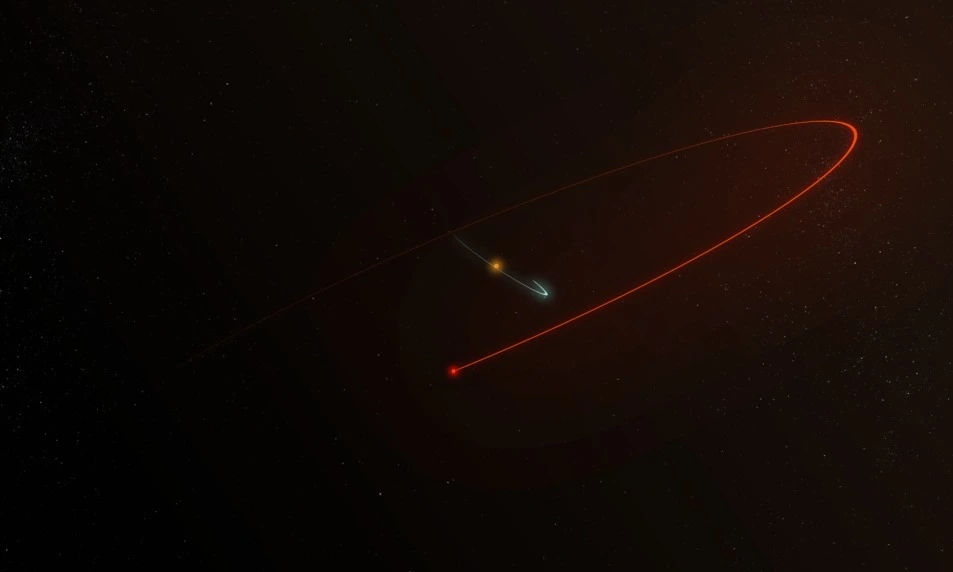
“This means that the planet around the main star will move in the opposite direction compared to the second luminary,” say the authors.
Only 4% of known exoplanets are located in binary systems. The reason for this, on the one hand, is that they are difficult to detect, and according to scientific models, the presence of 2 stars destabilizes the planet-forming disk.
Gas giants take 5 to 10 million years to form, although the gas and dust disk in binary systems is thought to persist for only 1 million years. The fact that GJ 896A and GJ 896B belong to the red dwarf type makes the formation of a similar exoplanet in their vicinity even more surprising.
According to the researchers, these models may need to be revised. The new paper was published in The Astronomical Journal.



Discussion about this post